How to Succeed in Cyberpunk Without Really Trying.
“Love, Death, and Robots”AKA“Sex, Bearded White Men, and Boobs”How to Succeed in Cyberpunk Without Really Trying.

When I saw the trailer for Love, Death, and Robots, an 18 episode-long, animated anthology series on Netflix categorized “cyberpunk” in genre, I felt immediately pandered to. As I began the first episode, “Sonnie’s Edge”, I felt as if someone had reached into the depths of my desires and created something straight from a dream I probably had once. It had everything I could want: beautiful animation, a post-apocalyptic fight club with giant Kaiju-looking creatures, and badass women getting smooched. Was I anticipating animated breasts? No. But I wasn’t complaining... yet.
I was enjoying myself until I hit episode seven, “Beyond the Aquila Rift”. Up until this episode, I was letting my love of the uniquely breathtaking animation and world-building of a dystopian commentary of society, which I am always a sucker for, get in the way of me noticing the pattern. Save for two episodes— “Three Robots” and “When the Yogurt Took Over”—there were three reoccurring themes that I began to pick up on: sex, bearded white men, and naked women. I noticed all of these things come to a head three minutes into episode seven, which, for the sake of brevity, I will refer to as Aquila. There will also be some potential spoilers for some episodes of this show so continue at your own risk.
To begin, I stopped in the middle of Aquila to write the beginning of this so I wouldn’t lose the idea, then felt bad for prematurely judging it. I closed my laptop, finished the episode, and was still left with this weird feeling; my judgement remained. So, I opened the laptop back up, guiltfree.
It should be said that when I began this piece, I had only finished half of the show. I have finished it and can say with confidence that I genuinely enjoyed it. However, this is not meant to be a comprehensive review of the show, but to shine a light on common tropes and ideas depicted in dystopian-themed media, especially cyberpunk. I will only be focusing on a few episodes. So, let’s start with the first thing I noticed.
WHITE GUYS GALORE
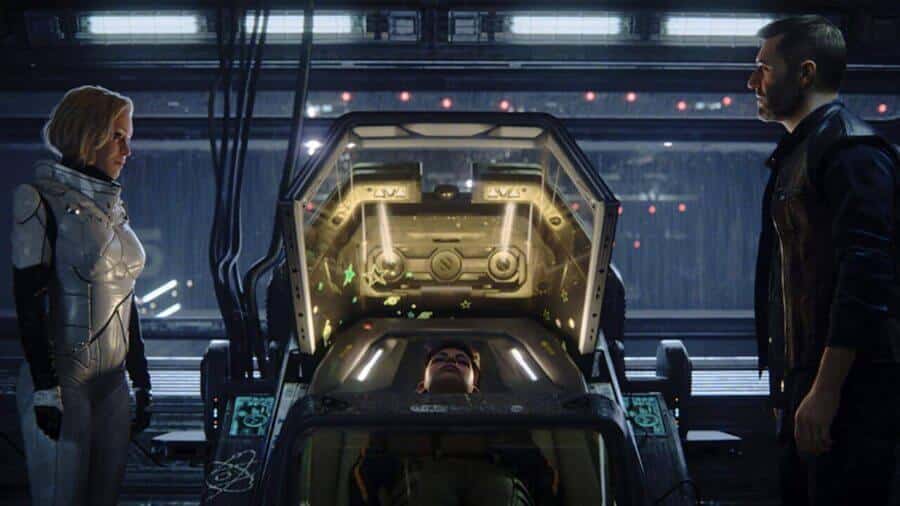 |
As stated before, I noticed these things at the beginning of Aquila. The episode begins with our main character, Thom, and his crew, Suzy and Ray. They plan their space trip and enter their respective age preserving goo-tanks. Thom then wakes up to find that, uh-oh, something went wrong, and they ended up “off course”. In the end, it turns out that they never woke up from their goo naps and Thom was being kept in this dream-like state by his ex, Greta, who wasn’t really Greta and was probably this gross spider-like creature holding him captive in this perpetual torture state. Like many anthology episodes, the ending is left “ambiguous”. The plot of the episode is not what bothered me; none of the episode plots did. It was the execution. The first thing I noticed was our white, bearded protagonist, Thom. Three episodes before this, “The Witness”, “Suits”, and “Sucker of Souls”, featured white, bearded men as their main characters. At first look, this may not seem that big a deal. But, when put into perspective, is actually a huge deal.
The concept of the “Average Hero” was noticed in the gaming industry a couple years ago, with the reveal of several games all with similar looking and feeling protagonists. While the video game landscape of heroes has changed quite a bit, the trend has by no means come to an end. In Aquila, Thom’s crew, Suzy, a woman of color, and Ray, a black man, mostly remain in their tanks, letting Thom do most of the work; Ray has about three lines. Seeing this, in and of itself, perpetuates that even in the far, far future, people of color take a back seat to the white protagonist. Of course, the show has other protagonists of different genders, colors, and sizes, but to have more than three episodes with main characters of the same archetype just seemed a bit fishy to me. Moving on!
SEX SELLS...?

I have never understood the obsession with sex in the future. Whether it’s sex robots, sex clubs, both, or even sex-obsessed radio hosts, there has always been this certain expectation of including some sort of sexual theme in a future-minded production. Now, as someone who has played several games with sex scenes, they have never made me feel... comfortable to say the least. Animated sex has always been weird, no matter who you are... unless you’re into that sort of thing, to which I would say: sorry to kinkshame you. But the gaming community as a whole has always been a little “iffy” when it came to the horizontal tango in games. And Love, Death, and Robots didn’t make it any better.
Aquila had a sex scene that I scrambled with my controller to skip; the realistic animation style didn’t make it any better. Now, I understood this to be an “adult” show, but I wasn’t anticipating the needless focus on sex that it actually has. The first “sexy” scene of the show in episode one, “Sonnie’s Edge”, caught me by surprise. They really just jumped into a lesbian makeout scene like it was nobody’s business. Then I saw animated boobs, which I will talk more about (God, that sound’s weird) and I felt... okay? Then I got duped when the blonde woman literally grew TALONS and stabbed Sonnie. Then I felt queerbaited and angry (“They had us in the first half, not gonna lie”). The point is, it was the first episode, so I was just thinking “they probably wanted to start off with a bang”. And that they did. Then, episode three hit.
Episode three, titled, “The Witness”, has some of the most beautiful animation I have ever seen. It has the best art style in the show for me so far. But this time, the animation or plot wasn’t enough to distract me from the overt emphasis of sex in this episode. I will talk more about my feelings on this episode when I talk about boobs—still weird—but in short, they had the main character be some sort of dancer in this BDSM-like sex club and the audience was given an incredibly gratuitous scene in which we are shown animated pubic hair. The only sex related thing I’ve enjoyed in the show thus far was a joke in “Sucker of Souls”. You’ll know it when you hear it. Overall, I think that this whole Sexy Future thing we’ve got going on isn’t really cool. And the reason why can be found in the final segment, the one you all have been waiting for...
ANIMATED BOOBS AREN’T AS FUN AS ONE WOULD THINK

Seeing and looking at boobs has never been something that necessarily bothered me. I am a woman, I have them, no big deal. But the objectification of women’s bodies; that definitely bothers me. The objectification of women is nothing new in media, so I won’t go into some long history lesson of when or why it started; we all know it exists. But man, in this show, it got old really quick. Like, almost immediately.
It caught me off guard in “Sonnie’s Edge”, and the whole dance scene in “The Witness”; but what really got me was what happened after that scene. To summarize, the episode follows a woman who witnesses a murder and is seen by the murderer and spends the length of the episode trying to run away from him. The man follows our protagonist to her work, the sex club, and watches her dance. She notices him in the crowd and runs of stage completely naked. She then proceeds to run through the streets with nothing but a kimono. We are still presented with full-frontal nudity. Why? Why couldn’t she have tied the kimono closed?
“But Sam, she was outrunning a murderer, she didn’t have time to do that.” Shut up, Bryce, you just wanted to see a naked woman. It was just so absurd, I don’t even know what to say anymore. Her being fully nude and being a dancer did nothing to elevate the plot or push the story forward. She could have been a waitress at a cyberpunk Denny’s and it would’ve played out the same way. Don’t even get me started on the scene in Aquila in which Greta is topless and is messing with the holographic map as if the audience isn’t going be a little distracted*. These instances are literally reflective of the writers and artists not caring about these women being objectified, ogled, obviously for the male gaze. No matter how you dice it, this is harmful. Putting these animated women in front of an audience, completely naked in situations that don’t call for it, they might as well just put up a screen for 15 minutes that says, “women exist only for entertainment”. On top of this, their bodies didn’t differ in design; they all had tiny waists, perky breasts, and thigh gaps. This just reinforces the fact that if their going be naked, they better look as made-up and perfect as possible.
CONCLUSION

I need to take a nap after writing this. Look, as it has been said, art imitates life, and if in our art, we display women as objects, use sex as a tool, and keep making bearded white guys our heroes, it will continue to bleed into society. And if this is the future that we are going into, I don’t think I want to be a part of it. But it’s not all sad. I know we are making strides forward in media, but this show, more specifically these episodes, just felt like a huge step backwards. Again, I find it enjoyable, I do. I just really needed to shine a light on these ideas and hopefully show you why it’s something that should be pointed out.
It’s good to critique media, even if you enjoy it. And that’s the tea.
*Both the Sex Sells and Animated Boobs themes are present in the episode Good Hunting. It also includes depictions/allusions to sexual assault and racism.
Comments
Post a Comment