Life is Strange as a Mobile Game
Console to Mobile: Life is Strange as a Casual Game
 |
| Figure 1: https://store.steampowered.com/app/319630/Life_is_Strange__Episode_1/ |
Life is Strange (Figure 1) is a 5-part, episodic game developed by Dontnod throughout 2015. The game follows the protagonist, Max, as she discovers that she has the power to rewind time. The outcome of the game depends on your choices; sometimes, players can rewind to test the different endings. I chose Life is Strange—which I will be referring to as LIS for brevity—to reimagine as a casual mobile game because there are already several mobile games that act as interactive stories, which is what LIS is at its core. Chapter 9 of our text, The Evolution of Video Games, lays out several design components that make up casual games, which I will be following to turn LIS into a game easily accessible to mobile gamers.
 |
| Figure 2: https://teamrumblebee.itch.io/lisvn |
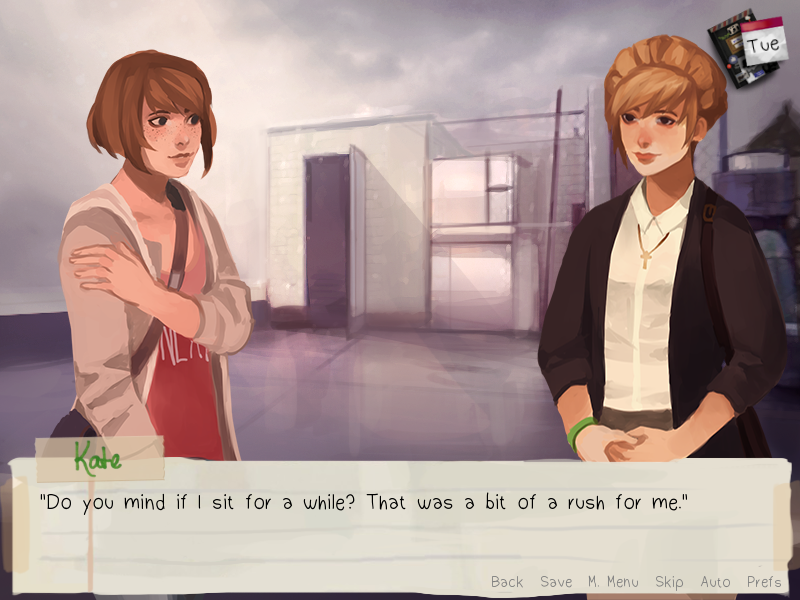
The first design element of mobile games is “fiction: games are usually set in a pleasant environment”. While the story of LIS can get dark at times, the art style is nothing but aesthetically pleasing. Its cartoony character design and comic-like environments make it perfect for a casual game. In 2016, a small indie development team by the name Rumblebee created a small dating-simulator based on LIS, taking its characters and locations and making it more suited for the games genre (Figure 2). This is a lot like what it would like on mobile.
 |
| Figure 3: https://www.bluestacks.com/apps/simulation/choices-stories-you-play-on-pc.html |
Next, the game should be usable: it should “require little in the way of previous familiarity with video game conventions”. Much like the infamous mobile game Choices (Figure 3), most known for their ridiculous adds, the gameplay of the casual version of LIS would consist of just reading and picking choices, and sometimes, rewinding. This would be as easy as pressing a small “rewind” icon or something of the sort. The next design element, which also ties into Choices, would be “interruptibility: gamers can play in short bursts”. One of the best features of Choices is its ability to pick up exactly from where you left off, and the LIS game would do the same. Players would be able to pick up the game, play for as long as they felt, close the app, then, when picked up, it would be on the screen that they last saw.
Like many mobile games, the fourth design element, difficulty and punishment would practically be nonexistent. Usually, the “games do not require players to replay whole sections of a game if a mistake is made”. This would be due to the rewind feature; if the players make a mistake or just want to pick a different choice, they will be able to press rewind, taking them to the last choice made.
Finally, the last design element: “juiciness”. In chapter 9, this is defined as the provision of “excessive positive feedback—bounces, squirts, and so on”. This would be evident through immediately seeing the results of your choices in game. Unlike the full game, in which the consequences of your choices are usually revealed toward the end of an episode, or in a different episode entirely, the mobile version would provide players with their consequences immediately, giving them the space to rewind if they so wish. Making choices would also be embellished with visual cues and pretty designs and such.

Comments
Post a Comment